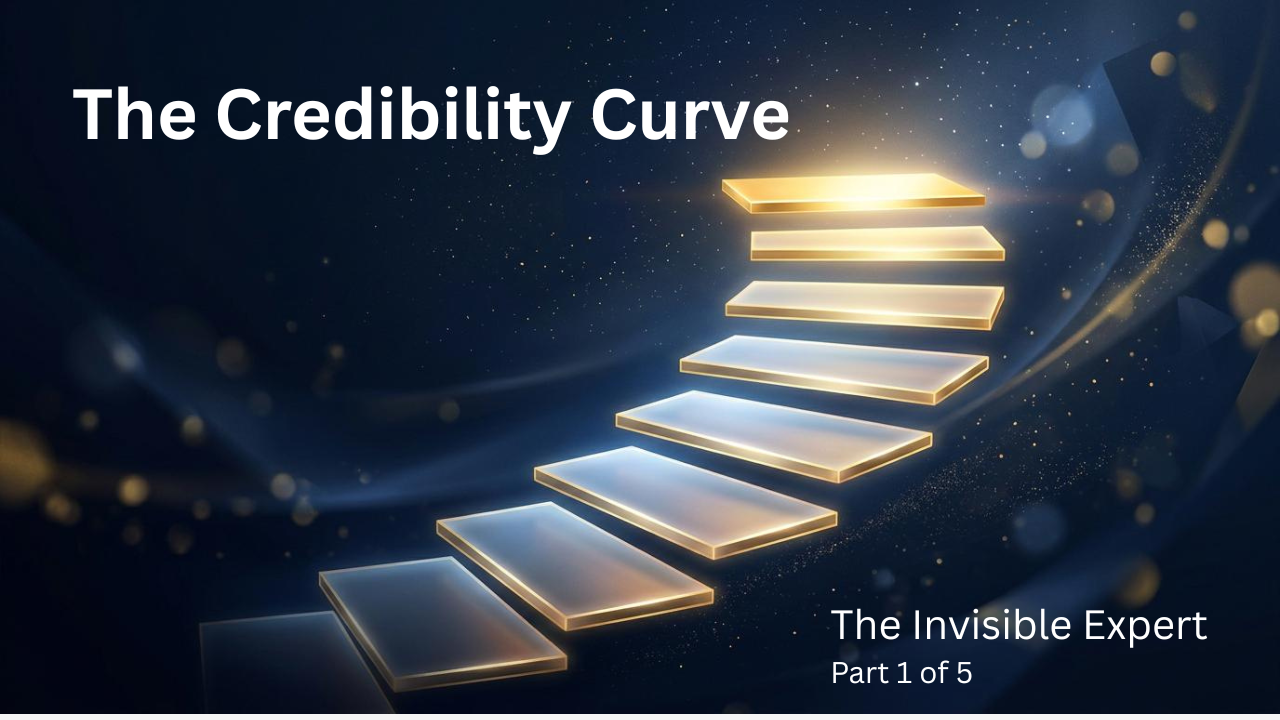
The Credibility Curve Series | Part 1 of 5.
There comes a point in many professional careers when experience alone stops being enough.
You’ve worked hard, built expertise, handled difficult assignments and earned the confidence of the people you work with. You have a respectable CV, a collection of achievements and probably a few colleagues who regularly turn to you when things get complicated.
Yet somehow, when opportunities arise outside your immediate circle, your name doesn’t always come up.
You watch people with similar qualifications and experience being invited to industry conversations, considered for leadership opportunities or recognised as experts in areas where you also have considerable knowledge.
You may even find yourself wondering what they know that you don’t.
I’ve come to believe that one of the biggest challenges experienced professionals face isn’t necessarily a shortage of expertise. It’s that the reputation they’ve built doesn’t fully reflect what they’re capable of.
And sometimes, they don’t realise this until they need that reputation to open a new door.
This is where the Credibility Curve begins.
The Credibility Curve: How Expertise Becomes Recognised Authority
Over the years, I’ve become increasingly interested in the relationship between professional experience, reputation and opportunity.
Why do some people become the obvious choice when an organisation needs an expert? Why are certain professionals regularly invited into conversations, while equally capable people remain largely unknown beyond their immediate networks?
Of course, there isn’t one explanation. Relationships, organisational cultures, timing and access to opportunities all play a role.
But one factor that deserves greater attention is how professional credibility develops.
We often assume that credibility comes automatically with experience. The longer we work in a field, the more credible we become.
Experience certainly gives us the opportunity to develop expertise, but credibility also depends on whether other people can understand, assess and trust that expertise.
This thinking informed the Credibility Curve, a five-stage framework I use to explore how professionals move from having valuable knowledge to developing reputations that extend beyond their immediate working environments.
The five stages are:
The Invisible Expert: Your expertise is established, but recognition remains limited.
The Emerging Voice: You begin contributing your perspectives to professional conversations.
The Credible Contributor: Your work and ideas provide evidence of expertise that others find useful.
The Recognised Authority: Your knowledge begins influencing how people think, make decisions or approach their work.
The Referenced Thought Leader: Your ideas become reference points that others independently use, share or build upon.
These stages are not determined by job titles, years of experience or social media followers. They also aren’t a rigid ladder that everyone must climb in the same way.
You could be a recognised authority in your organisation while remaining relatively unknown in a wider industry. You might also be highly credible in one field while still establishing yourself in another.
The framework is intended to help you examine where your professional reputation stands today and what it might take to strengthen it.
For this first article, I want to focus on a group of professionals who are often more accomplished than their visibility suggests. The Invisible Expert.
Who Is the Invisible Expert?
You probably know someone who fits this description.
They’re the person everyone calls when a difficult problem needs solving. They understand the business, know how things work and have the experience to anticipate challenges others might overlook.
They rarely need to announce how good they are. Their colleagues already know.
But outside that familiar environment, very few people have any idea what they bring to the table.
I think this is particularly common among professionals who have spent years building their careers within established organisations.
They become known for performing a particular function exceptionally well. Over time, that function becomes the identity people associate with them.
Consider a finance professional who has spent fifteen years working across financial planning, risk management and business improvement.
Within her department, she’s respected for her judgement and ability to handle complex decisions.
Yet when a strategic transformation initiative comes up, she isn’t considered.
The people selecting the team know her as a strong finance professional. They haven’t necessarily seen the broader business thinking she brings to her role.
Her experience hasn’t neccessarily disappeared, but the reputation surrounding that experience is narrower than her actual capability.
This is an important distinction.
Many professionals are recognised for the jobs they currently perform, but not necessarily for the contribution they’re capable of making beyond those jobs.
This becomes particularly frustrating when you’re ready for a career change, a more senior position or an opportunity to work in a different environment.
Suddenly, the professional reputation that has served you well for years may not be enough to support where you want to go next.
The Problem With Letting Your Work Speak for Itself
I grew up with the belief that if you worked hard, remained committed and delivered results, recognition would eventually follow.
It’s advice many of us received early in our careers, and I still believe there’s considerable value in it.
A professional reputation without competence behind it is difficult to sustain.
But experience has also taught me that doing good work doesn’t always mean the people who matter to your next career move know about it.
Think about how organisations operate.
Your manager may be familiar with your achievements, but other senior leaders might only see the final departmental results.
You may have played a critical role in a successful project, yet the contribution people remember is the presentation delivered by the project lead.
A client may appreciate the outcome of an assignment without fully understanding the expertise that made it possible.
And sometimes, the work that consumes the most effort is the work that receives the least attention because, from the outside, everything appears to have gone smoothly.
This is one reason I’ve become less convinced by the idea that professionals should simply keep their heads down and wait to be discovered.
You can do excellent work for years and still find yourself having to explain your value when a new opportunity emerges.
I explored this challenge in another article, You’re Not Being Overlooked. You’re Just Not Being Seen.
But within the Credibility Curve, there’s an earlier question worth addressing.
Before worrying about how visible you are, have you become clear about what makes your professional contribution valuable?
Because visibility can attract attention, but it doesn’t automatically establish credibility.
Three Reasons Experienced Professionals Remain Invisible
There isn’t a single reason why capable professionals struggle with recognition.
Some work in environments where opportunities are limited or contributions aren’t fairly acknowledged. Others have careers shaped by personal circumstances, organisational structures or access to professional networks.
Those realities shouldn’t be dismissed.
However, there are also aspects of our professional reputation that we can influence. Three stand out for me.
1. We’ve Allowed Our Job Titles to Define Us
Think about how you introduce yourself at a professional event.
“I’m a Marketing Manager.”
“I’m a Finance Director.”
“I’m an HR professional.”
There’s nothing wrong with these introductions. They provide context, but they tell people very little about what distinguishes your contribution.
I’ve met professionals with identical job titles whose capabilities couldn’t be more different.
One marketing leader may be exceptional at entering new markets. Another may specialise in building customer relationships. A third may excel at bringing together commercial strategy, communications and stakeholder engagement.
Their titles are similar, but the value they bring is not the same.
Unfortunately, many of us become so accustomed to describing ourselves through our roles that we struggle to explain our expertise beyond them.
This becomes even more apparent when we change employers or begin exploring opportunities outside our current industries.
A job title is useful shorthand, but it shouldn’t be the full definition of your professional identity.
2. Our Achievements Are Often Hidden in Plain Sight
I find it interesting how easily professionals can discuss the responsibilities they’ve held, yet struggle when asked to describe the contribution they’ve made.
Someone might tell you they’ve managed a department for ten years.
Ask what changed because of their leadership, and the conversation becomes more difficult.
Not necessarily because they achieved little.
Often, they’ve simply never taken the time to examine and document the results of their work.
Their achievements are scattered across performance reviews, presentations, project reports and conversations that happened years ago.
When they eventually need to demonstrate their experience to someone new, they have to reconstruct the evidence from memory.
This is especially common among people who are constantly moving from one assignment to the next.
They finish a project, celebrate briefly and move on.
Over time, they accumulate experience without building an accessible record of what that experience has produced.
Your achievements deserve more than a passing mention in an annual appraisal.
They are evidence of your professional value.
And while not every project or result can be shared publicly, particularly where confidentiality is involved, there are usually ways to communicate your contribution responsibly.
3. The People Who Know Our Work Are Often the Same People We Work With Every Day
There’s comfort in being surrounded by people who already understand what you’re capable of.
You don’t have to explain your background. Your colleagues know your strengths and trust your judgement.
But professional relationships can become quite contained, particularly when you’ve worked in the same organisation or industry for a long time.
Think about the people who would confidently recommend you for an opportunity today.
How many work in your department? How many are former colleagues? How many know your work beyond your current employer?
There’s no perfect number.
The question is whether the people who understand your capabilities are also connected to the opportunities you hope to pursue.
A professional preparing to move into consulting, for example, may discover that almost everyone who knows their expertise works within the organisation they’re planning to leave.
That doesn’t make their experience less valuable.
It does mean they have some relationship-building to do.
And this is where personal branding becomes relevant, not as an exercise in self-promotion, but as a deliberate effort to help the right people understand the value of your professional contribution.
How Do You Begin Building Professional Credibility?
One mistake I would caution against is responding to a lack of recognition by immediately increasing your online activity.
You don’t necessarily need to start posting on LinkedIn every day, launch a newsletter or attend every networking event.
Those activities may become relevant later.
But at this first stage, I’d encourage you to begin with something less visible and more personal.
Take stock of what you’ve built.
Start With the Problems You Know How to Solve
Instead of asking yourself what skills you possess, think about the situations where your experience has made a difference.
What kinds of problems do colleagues bring to you?
When have you helped a team find a way through a difficult situation?
Which challenges do you understand particularly well because you’ve dealt with them repeatedly?
You may discover that your greatest strength isn’t a technical skill or a qualification.
It might be your ability to bring people together, make sense of complexity, identify opportunities or turn ideas into workable plans.
These are often the capabilities that distinguish experienced professionals, yet they’re rarely captured adequately in a job description.
Build an Evidence Bank
I would encourage every professional to maintain a record of meaningful achievements throughout their career.
Not just for CV updates or performance appraisals.
For your own understanding of how your capabilities are developing.
Choose three achievements you’re particularly proud of and write down what happened.
What was the challenge? What role did you play? What changed as a result of your contribution?
Where possible, include measurable outcomes. Where that isn’t possible, describe the improvement or value created without exaggerating your role.
Be especially careful to recognise team achievements appropriately.
The purpose is not to claim credit for everything but to become more confident and accurate in explaining what you contribute.
Find Out What Others Actually Know You For
This is an exercise I’ve come to appreciate because it can reveal things we rarely notice about ourselves.
Ask a few people who have worked closely with you two questions:
– “What do you think I do particularly well?”
– “If you were recommending me for a professional opportunity, what would it be?”
Listen to their answers.
You might discover that people recognise a strength you’ve never considered central to your professional identity.
You may also find that the reputation you’ve built is quite different from the one you want to develop.
For example, you might want to move into strategic leadership, but everyone sees you primarily as an excellent executor.
That feedback gives you something useful to work with.
It helps you understand where your current professional reputation stands, rather than relying entirely on how you would like to be perceived.
A 15-Minute Professional Credibility Check
Before moving on to the next stage of the Credibility Curve, I’d like you to do a short exercise.
Find a quiet moment and answer these five questions. Write your responses down rather than simply thinking through them.
1. What do people currently come to me for?
Think about the problems you’re regularly asked to solve or the responsibilities people trust you to handle.
2. What would I like to be recognised for that people may not currently see?
Perhaps you’ve developed capabilities beyond your current role or have ambitions that aren’t yet reflected in your professional reputation.
3. Which three achievements best demonstrate my professional value?
Choose specific examples. What did you contribute, and what difference did it make?
4. Who knows about these capabilities?
Consider whether your expertise is understood only within your immediate working environment or by a wider circle of relevant professional contacts.
5. What’s one thing I could do this week to make my professional value clearer?
It might be updating your professional biography, documenting a significant achievement, seeking feedback or having a conversation with someone who can offer a different perspective on your strengths.
Once you’ve answered the questions, look at your responses together.
Is there a gap between what you know you’re capable of and what others currently recognise?
If there is, you’ve identified an area worth paying attention to.
Don’t feel pressured to address everything at once. Choose one practical action and begin there.
When Are You Ready to Move Beyond the Invisible Expert Stage?
I wouldn’t put a timeline on this.
Building a professional reputation is not a six-month project, and there is no universal checklist that guarantees you’ll become recognised as an authority.
But there are signs that you’re developing a stronger foundation.
You can explain your professional value without reciting your job description.
You have examples that demonstrate your capabilities.
You have a better understanding of how colleagues and professional peers perceive you.
And importantly, you know which aspects of your expertise you want others to recognise as your career develops.
That is progress.
It doesn’t mean everyone in your industry knows your name. Nor does it mean opportunities will suddenly begin appearing.
But you’ve started developing the clarity and evidence needed to build a more intentional professional reputation.
The next challenge is learning how to contribute that expertise to conversations beyond your immediate working environment.
And that brings us to the second stage of the Credibility Curve.
Coming Next: The Emerging Voice
One of the challenges I frequently see among experienced professionals is the hesitation to share what they know.
They have opinions, observations and practical lessons developed through years of work but they question whether their perspectives are worth sharing.
They worry that someone else has already said it better or that they don’t have enough authority to contribute.
In the next article, we’ll explore how to move beyond that hesitation and begin developing a professional voice that reflects your knowledge and experience.
We’ll also look at why meaningful participation matters more than simply producing large amounts of content.
Continue to Part 2: The Emerging Voice
Your Expertise Deserves to Be Understood
If you’ve recognised yourself as an Invisible Expert, consider this an invitation to take a fresh look at your professional reputation.
You may have spent years developing capabilities that are valuable to your organisation, your industry and the people around you.
But those capabilities won’t necessarily be apparent to someone who has never worked with you.
This is why I believe building professional credibility deserves deliberate attention throughout our careers, not just when we’re applying for a new job or considering a career change.
It’s an ongoing process of understanding our contribution, learning how others perceive us and making the evidence of our expertise more accessible.
The Credibility Curve gives us a way to think about that process.


